
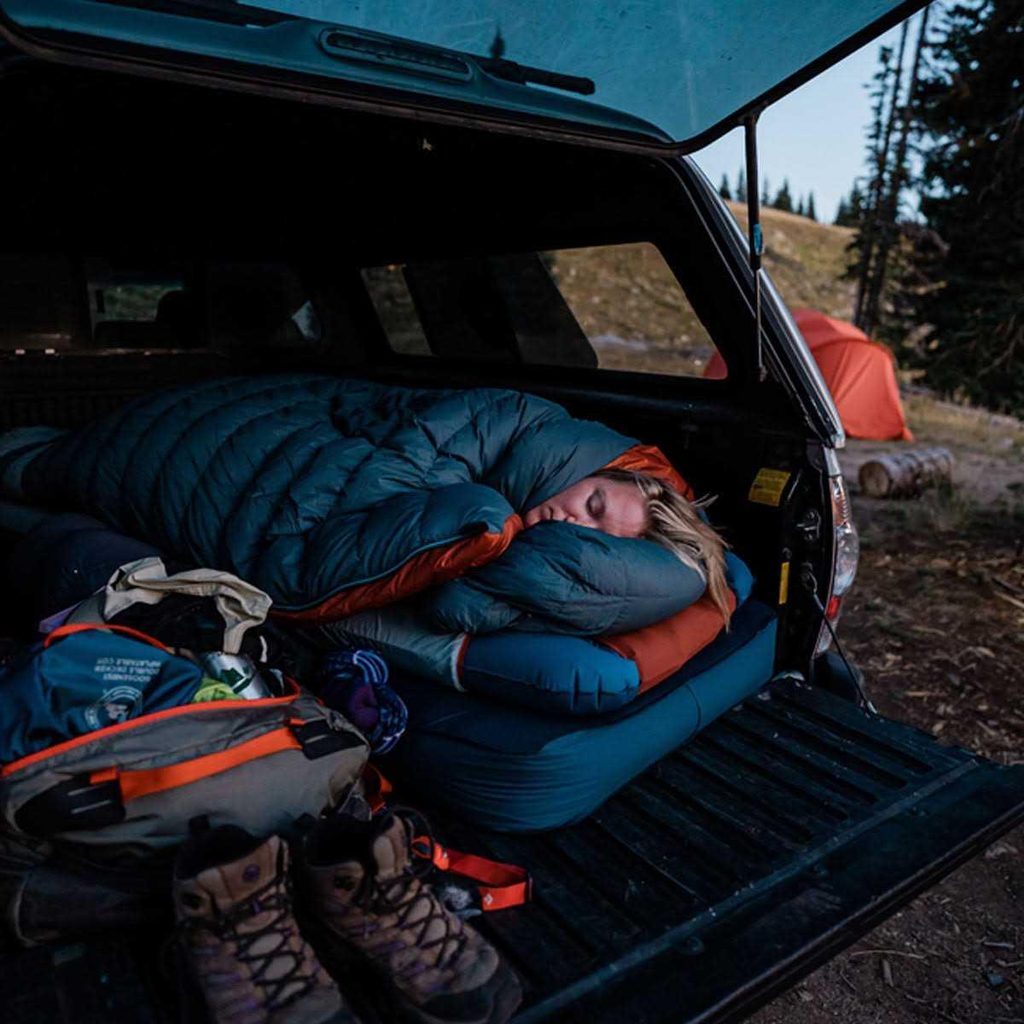
When choosing a camping sleeping pad, thickness and comfort are important—but there is another number you should pay attention to: R-value.
R-value measures how well a sleeping pad resists heat loss through the ground. A higher R-value generally means better insulation, which can make a big difference when camping in cold weather.
But what R-value do you actually need?
For most beginner campers, an R-value around 2 to 4 can be a good starting point for mild to three-season camping. If you regularly camp in colder temperatures, you may want an R-value of 4 or higher.
The right choice depends on the season, nighttime temperature, camping style, and how sensitive you are to cold.
Let’s break it down.
What Is R-Value on a Sleeping Pad?
R-value is a measurement of thermal resistance.
In simple terms, it tells you how well your sleeping pad helps slow down heat moving from your warm body toward the colder ground.
When you sleep in a tent, your sleeping bag provides insulation around your body. However, the insulation underneath you can become compressed by your body weight.
That is where a sleeping pad becomes especially important.
A sleeping pad provides two main things:
- Cushioning and comfort
- Insulation from the ground
The thickness of a sleeping pad mainly affects comfort and cushioning, while R-value is specifically related to insulation.
This is why a thicker sleeping pad is not automatically warmer.
For more information about thickness, see our guide:
How Thick Should a Camping Sleeping Pad Be?
Why Does R-Value Matter When Camping?
The ground can feel surprisingly cold at night.
Even when the air temperature doesn’t seem extremely low, the ground can pull heat away from your body.
If your sleeping pad doesn’t provide enough insulation, you may notice that your back, hips, or legs feel cold during the night.
A sleeping bag can’t completely solve this problem because the insulation underneath your body is compressed.
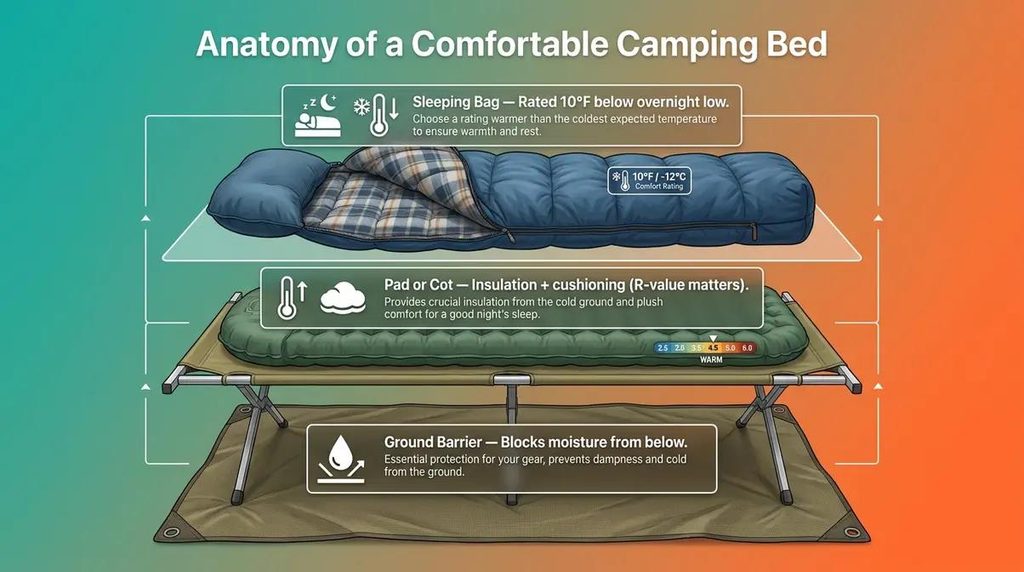
That’s why your sleeping system should be thought of as a combination of:
Sleeping bag + sleeping pad + appropriate clothing + shelter
A good sleeping pad helps prevent the cold ground from becoming the weak point in your sleep system.
What R-Value Do You Need for Camping?
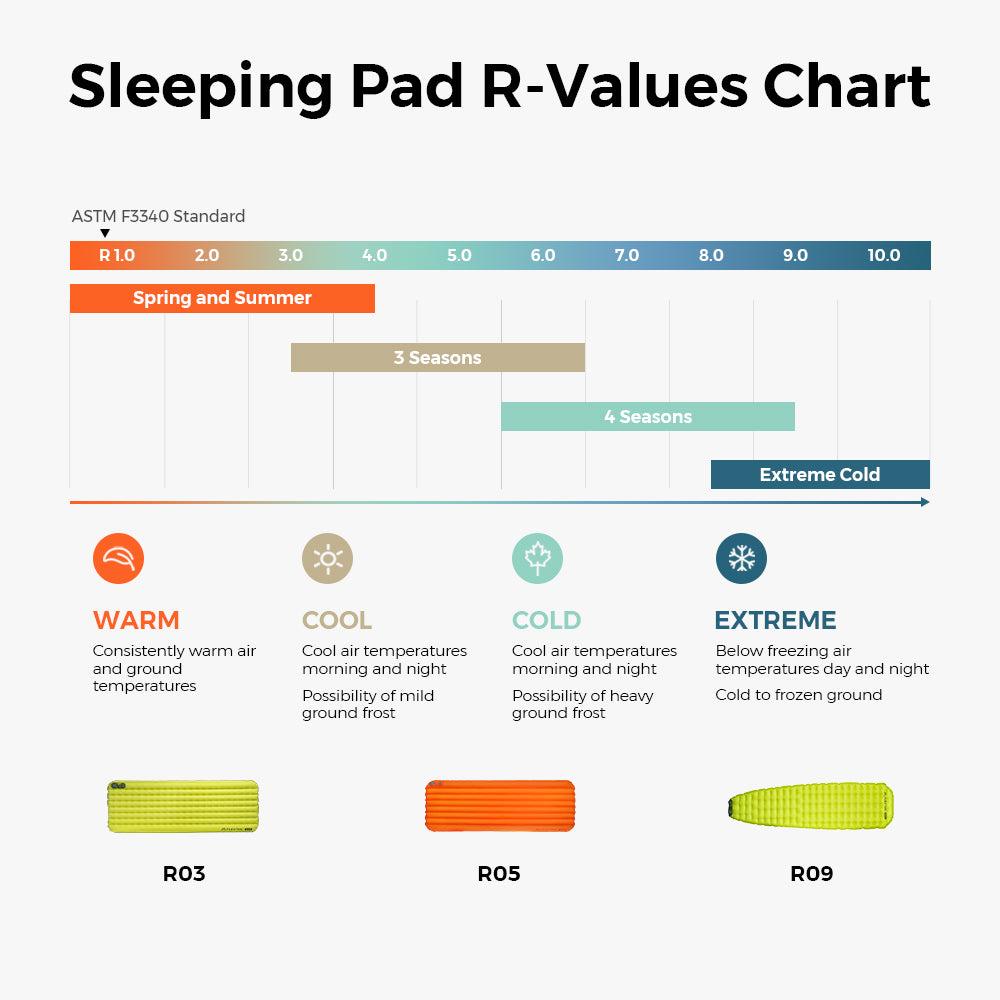
There isn’t one perfect R-value for every camper.
As a general starting point:
| R-Value | Typical Use | General Conditions |
|---|---|---|
| Under 2 | Warm-weather camping | Summer and mild nights |
| 2–3 | Three-season camping | Spring, summer, fall |
| 3–4 | Cooler three-season camping | Cold spring/fall nights |
| 4–5 | Cold-weather camping | Colder temperatures |
| 5+ | Winter camping | Snow and freezing conditions |
These ranges are useful for planning, but they shouldn’t be treated as exact temperature guarantees.
Your personal comfort, sleeping bag, clothing, tent, campsite, and weather conditions all matter.
Is an R-Value of 2 Enough for Camping?
For warm-weather camping, an R-value around 2 can be perfectly reasonable.
If you’re camping during summer and nighttime temperatures remain comfortably above freezing, you may not need a very high R-value.
An R-value around 2 can provide a good balance between:
- Weight
- Pack size
- Comfort
- Insulation
- Price
However, if you frequently camp during early spring or late fall, you may want something with more insulation.
If you’re buying one sleeping pad for a variety of conditions, an R-value around 3 or higher can provide more flexibility.
Is an R-Value of 3 Good for Camping?
For many campers, R-value 3 is a practical middle ground.
It can work well for general three-season camping, especially when nighttime temperatures are cool but not extremely cold.
This makes it a popular range for beginners who want one sleeping pad that can handle more than just summer camping.
If your camping trips usually involve:
- Spring camping
- Summer camping
- Fall camping
- Car camping
- Mild mountain conditions
an R-value around 3 can be a reasonable choice.
However, always check the expected nighttime temperature before relying on a particular sleeping setup.
Is an R-Value of 4 Good for Camping?
An R-value around 4 provides more insulation and is a better option if you regularly encounter colder nights.
It can be useful for campers who want more flexibility during shoulder seasons.
For example, if you enjoy camping in:
- Early spring
- Late fall
- Higher elevations
- Colder regions
- Chilly nights
a sleeping pad with an R-value of around 4 can provide a useful extra margin of insulation.
If you tend to get cold easily, choosing a somewhat higher R-value can also be worthwhile.
What R-Value Do You Need for Winter Camping?
Winter camping is a different situation.
If you’re camping in freezing conditions or on snow, a low-R-value sleeping pad may not provide enough insulation.
For true winter camping, many campers look for sleeping pads with an R-value of 5 or higher.
The colder the conditions, the more important insulation becomes.
Winter sleeping systems can also use two sleeping pads together to increase overall insulation.
For example, a closed-cell foam pad can be placed underneath an insulated inflatable sleeping pad.
This can provide:
- Additional insulation
- Extra protection from the ground
- Backup protection if an inflatable pad fails
- Additional cushioning
However, winter camping requires more than simply buying a high-R-value sleeping pad. Your sleeping bag, clothing, shelter, campsite, and weather conditions all need to be appropriate for the conditions.
Does a Higher R-Value Mean a Warmer Sleeping Pad?
Generally, yes.
A higher R-value means the sleeping pad provides more resistance to heat transfer.
That usually makes it better suited to colder conditions.
But there is an important distinction:
Higher R-value does not necessarily mean more comfortable.
A pad with an R-value of 5 isn’t automatically softer or more comfortable than one with an R-value of 3.
Comfort depends on factors such as:
- Thickness
- Construction
- Shape
- Surface design
- Inflation pressure
- Your sleeping position
If comfort is your main concern, don’t look at R-value alone.
Our guide to sleeping pad thickness explains this in more detail:
How Thick Should a Camping Sleeping Pad Be?
R-Value vs Sleeping Pad Thickness
This is one of the most common sources of confusion for beginners.
A sleeping pad can be thick without having a particularly high R-value.
For example, an uninsulated air mattress can feel very comfortable and thick but may provide less insulation than you expect in cold conditions.
On the other hand, a thinner sleeping pad can sometimes provide surprisingly good insulation if it uses effective insulating materials or construction.
Think of the two measurements this way:
Thickness = primarily comfort and cushioning
R-value = insulation
You need to consider both.
What R-Value Is Best for Each Season?
Your ideal R-value can change depending on when you camp.
Summer Camping
For warm summer conditions, an R-value around 1.5–2.5 may be enough for many campers.
If nighttime temperatures remain warm, you may not need a heavily insulated sleeping pad.
A lower-R-value pad can also be lighter and easier to pack.
Spring and Fall Camping
For cooler spring and fall conditions, an R-value around 3–4 can be a practical choice.
Shoulder-season weather can change quickly, so having additional insulation can make your sleeping system more versatile.
Cold Weather Camping
For colder conditions, consider an R-value around 4–5 or higher, depending on the expected temperatures.
The colder the ground and air, the more important your sleeping pad’s insulation becomes.
Winter Camping
For serious winter camping, an R-value of 5+ is commonly a better starting point.
Some winter campers use multiple pads to increase insulation and create a backup sleeping system.
Can You Combine Two Sleeping Pads?
Yes.
Using two sleeping pads can be an effective way to increase insulation.
For example, you might place a closed-cell foam pad underneath an insulated inflatable pad.
The combined system can provide more insulation than either pad alone.
This approach can be especially useful for colder camping trips.
It also provides some redundancy.
If your inflatable pad loses air overnight, the foam pad underneath can still provide some cushioning and insulation.
For beginners, however, it’s usually better to start with one appropriate sleeping pad before building a more complicated sleep system.
Does R-Value Matter for Car Camping?
Absolutely.
You don’t need to carry your gear on your back for R-value to matter.
In fact, car campers have an advantage: you can usually bring a larger and more comfortable sleeping pad without worrying as much about weight or packed size.
If you mainly car camp, you may choose a higher-R-value pad because the small increase in weight may not matter much.
For example, instead of buying the lightest possible summer pad, you could choose a more insulated pad that works across a wider range of conditions.
This can make your gear more versatile.
What R-Value Should Beginners Buy?
If you’re buying your first sleeping pad and mostly plan to camp during warmer months, you don’t necessarily need an extremely high R-value.
For general three-season camping, around R-value 3 is a reasonable starting point for many beginners.
If you want more cold-weather flexibility, moving toward R-value 4 or higher can make sense.
A simple way to think about it is:
- Mostly summer camping → around 2
- General three-season camping → around 3
- Cooler spring/fall camping → around 3–4
- Cold-weather camping → around 4–5+
- Winter camping → generally 5+
These are planning ranges rather than strict rules.
Always check the actual conditions you’ll be camping in.
What About Your Sleeping Bag?
Your sleeping pad and sleeping bag work together.
A warm sleeping bag can’t completely compensate for a poorly insulated sleeping pad.
Imagine sleeping in a high-quality sleeping bag on cold ground with very little insulation underneath you.
The ground can still pull heat away from your body.
That’s why choosing a sleeping pad based on both comfort and insulation is important.
You can learn more about sleeping bag temperature ratings here:
Sleeping Bag Temperature Ratings Explained for Beginners
And if you’re still choosing a sleeping bag, see:
How to Choose the Right Sleeping Bag for Your Camping Trip
What About R-Value and Sleeping Position?
Your sleeping position doesn’t directly determine the R-value you need, but it can affect how you experience your sleeping system.
Side sleepers often prioritize thicker pads because they need more cushioning around the hips and shoulders.
Back and stomach sleepers may be comfortable with a thinner pad.
This is another reason not to confuse thickness with insulation.
A side sleeper might want:
- 3–4 inches of thickness
- An R-value appropriate for the season
Those are two separate decisions.
You can have both comfort and insulation without assuming that one measurement determines the other.
What If You Get Cold Easily?
If you naturally sleep cold, consider choosing a sleeping pad with more insulation than the minimum required for the conditions.
For example, if an R-value of 2 would technically work for a summer trip, an R-value of 3 may provide a more comfortable margin.
Other ways to stay warmer include:
- Wear dry sleeping clothes
- Use an appropriate sleeping bag
- Avoid sleeping directly on cold ground
- Choose a sheltered campsite
- Use a tent with appropriate ventilation
- Consider layering sleeping pads in colder conditions
Your personal comfort matters.
The goal isn’t to buy the highest R-value possible. It’s to choose enough insulation for the conditions you’ll actually encounter.
Don’t Choose a Sleeping Pad by R-Value Alone
R-value is important, but it shouldn’t be the only thing you consider.
Before buying a sleeping pad, look at:
1. R-Value
Does it provide enough insulation for your typical camping season?
2. Thickness
Is it thick enough for your sleeping position and comfort preferences?
3. Weight
Does the weight matter for your camping style?
4. Packed Size
Will it fit easily into your backpack or vehicle?
5. Pad Type
Is it an inflatable, self-inflating, or closed-cell foam pad?
6. Durability
Can it handle the type of campsites you normally use?
7. Price
Does the performance justify the cost for your actual camping needs?
A $200 sleeping pad isn’t automatically better for you than a $60 sleeping pad.
The right choice depends on how and when you camp.
A Simple R-Value Buying Guide
If you’re still unsure, use this quick decision guide.
Mostly warm-weather camping?
Look for an R-value around 2.
Want one pad for general three-season camping?
Around R-value 3 is a practical starting point.
Regularly camp in cold spring or fall conditions?
Consider R-value 3–4 or higher.
Planning cold-weather camping?
Look toward R-value 4–5+.
Planning winter camping on snow or in freezing conditions?
Consider a winter-rated sleeping system with R-value 5+ and pay close attention to the entire sleep system.
Final Thoughts
So, what R-value do you need for a camping sleeping pad?
For many beginners, an R-value around 3 is a good starting point for general three-season camping.
If you mostly camp in warm summer weather, around 2 may be enough. If you regularly camp during colder spring and fall conditions, moving toward 4 can provide more insulation. For winter camping, you’ll generally want a significantly higher R-value.
The most important thing is to choose based on your actual camping conditions rather than simply buying the highest number available.
Remember:
Thickness is mainly about comfort.
R-value is about insulation.
A great sleeping pad balances both.
Once you understand the difference, choosing a sleeping pad becomes much easier—and you’ll be better prepared for comfortable nights outdoors.
Want to learn more? Check out these related camping guides:
→ How to Choose a Camping Sleeping Pad
→ How Thick Should a Camping Sleeping Pad Be?
→ Sleeping Pad vs Air Mattress