
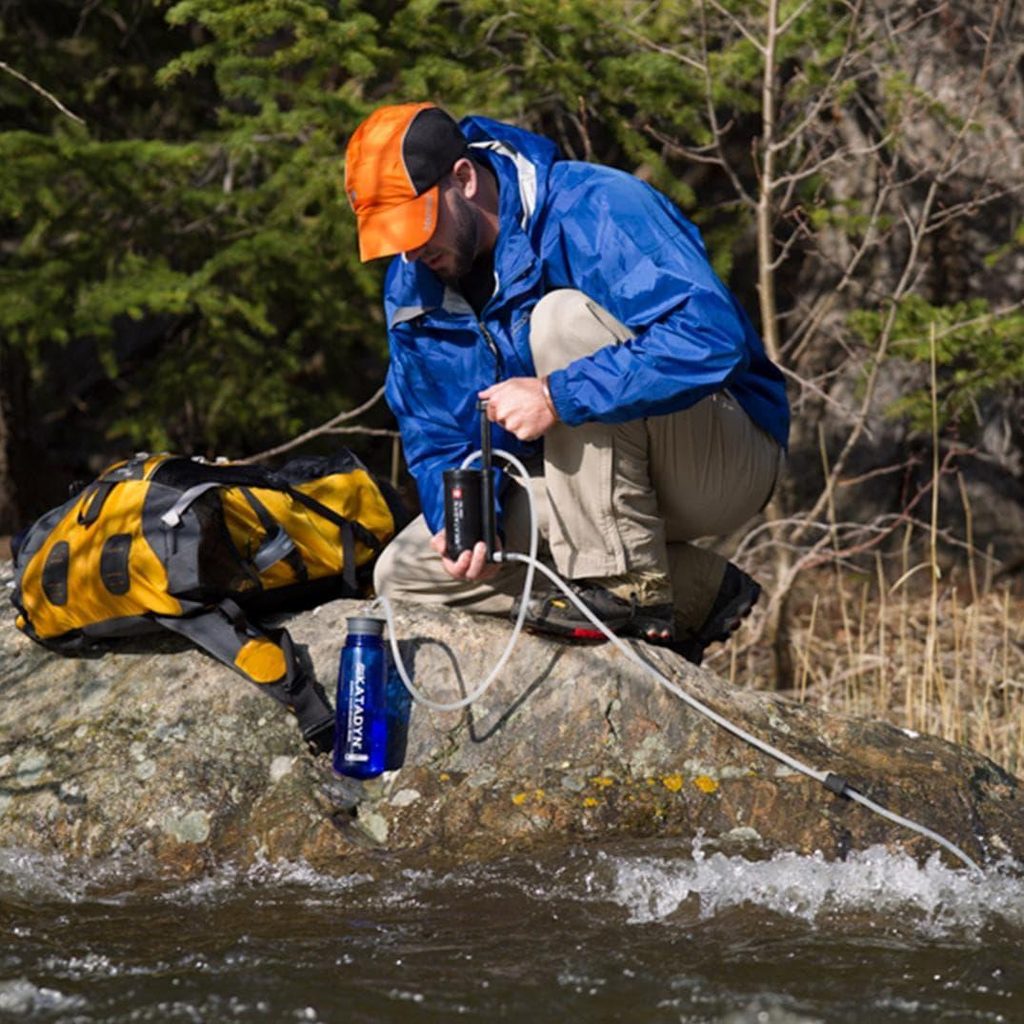
Having access to safe drinking water is one of the most important parts of any camping trip.
If you are camping at a developed campground, you may have treated water available from a faucet. But when you camp farther from facilities, hike into remote areas, or travel to places without reliable drinking water, a portable water filter can become extremely useful.
The challenge is knowing which type of water filter you actually need.
Camping water filters come in different sizes, filtration methods, capacities, and designs. Some are made for filling a bottle at a stream, while others are designed to process larger amounts of water for groups.
In this guide, you’ll learn how camping water filters work, what features matter, and how to choose the right one for your camping style.
1. Do You Really Need a Camping Water Filter?
Not every camper needs a water filter.
If you are staying at a campground with a reliable potable-water source, bringing enough water may be simpler.
A water filter becomes more useful when you:
- Camp away from developed facilities
- Backpack or hike into remote areas
- Use natural water sources
- Travel for several days
- Need to reduce the amount of water you carry
- Want a backup water-treatment option
The right choice depends on your destination and the water sources available there.
2. Understand What a Water Filter Does
A water filter physically removes particles and certain microorganisms from water.
Depending on the filter design, it may reduce contaminants such as bacteria, protozoa, sediment, and other particles.
However, not every water filter removes every type of contaminant.
This is one of the most important things beginners should understand.
A filter’s specifications should tell you exactly what it is designed to remove.
Never assume that a filter makes every natural water source safe to drink.
3. Water Filter vs Water Purifier
The terms “filter” and “purifier” are sometimes used interchangeably, but they are not necessarily the same.
A water filter generally uses a physical barrier to remove specific contaminants.
A purifier is designed to provide a broader level of treatment and may use additional technology such as chemicals or ultraviolet light.
The right choice depends on the water sources you expect to encounter.
If you are traveling internationally or using water sources where viruses are a concern, check the product’s specific treatment claims rather than assuming a standard filter is sufficient.
4. Consider Where You Will Get Your Water
Think about your typical camping environment before buying a filter.
Developed Campgrounds
You may not need a filter at all if potable water is available.
Lakes and Rivers
A filter can be useful when you need to collect water from natural sources.
Streams
Streams can provide convenient water sources, but clear-looking water is not automatically safe to drink.
Remote Backcountry Areas
A reliable water-treatment system becomes much more important when you are far from facilities.
Your water source should determine your filtration and treatment strategy.
5. Choose the Right Filter Type
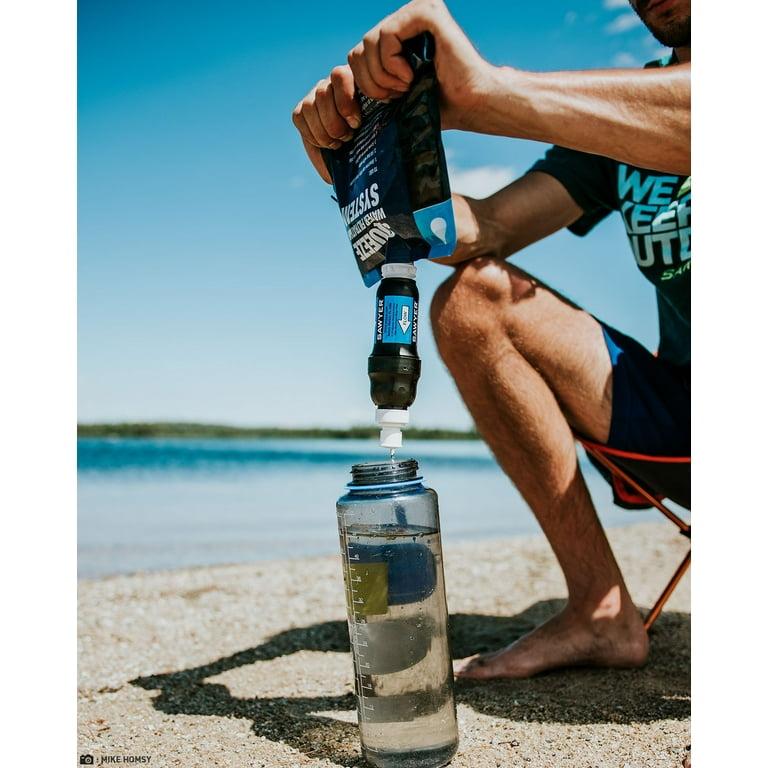
Camping water filters come in several common designs.
Straw Filters
These are compact and simple.
You drink directly through the filter from a water source or compatible container.
They can be convenient for emergency use or individual hikers, but they are less flexible if you need to fill a bottle or prepare water for cooking.
Squeeze Filters
Squeeze systems allow you to collect water in a soft bottle and push it through the filter.
They are popular because they are relatively lightweight and versatile.
You can use them to fill a bottle or another container.
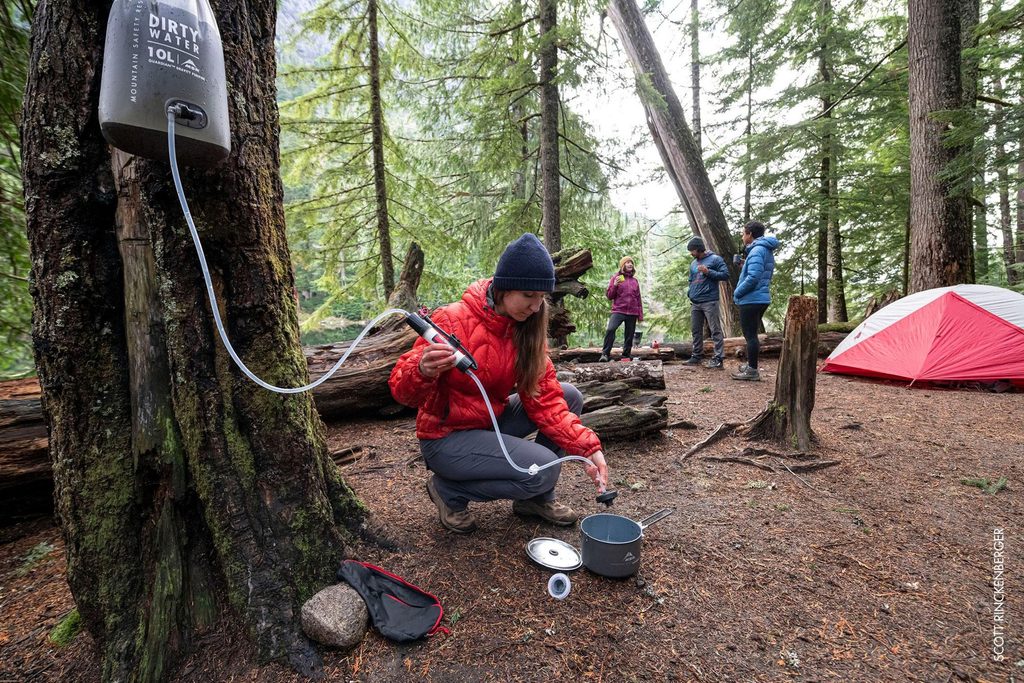
Gravity Filters
Gravity systems use elevation instead of hand pressure.
Dirty water is placed in an upper container and flows through the filter into a clean container.
This can be convenient when you need to process several liters of water.
Pump Filters
Pump filters use a manual pump to force water through the filter.
They can work well when water needs to be collected from shallow or difficult-to-access sources.
The downside is that pumping can require more effort.
6. Think About How Much Water You Need
Your daily water needs should influence the type and capacity of filter you choose.
A solo camper may only need a small filter.
A group of four or five people may benefit from a higher-capacity gravity system.
Ask yourself:
How much water will I need to treat at one time?
If you regularly camp alone, carrying a large system may simply add unnecessary weight.
If you regularly camp with a group, a tiny individual filter may become inconvenient.
7. Check the Flow Rate
Flow rate tells you how quickly water can pass through the filter.
A faster flow rate can make collecting drinking water much easier.
For example, imagine you need to fill a large water container.
A slow filter may require significant time and effort.
A higher-flow system can make the process more convenient.
However, manufacturers’ flow-rate figures can vary depending on water quality, filter condition, pressure, and other factors.
Treat flow rate as a comparison point rather than the only specification that matters.
8. Consider the Filter’s Capacity
Water filters have different rated capacities.
Some are designed for occasional individual use, while others can process much larger amounts of water before the filter needs to be replaced.
If you camp frequently, a longer-lasting filter may be more convenient.
If you only camp a few times each year, a smaller system may be perfectly adequate.
Check the manufacturer’s stated filter life before purchasing.
9. Think About Weight
Weight matters more if you carry your water filter in a backpack.
For car camping, an extra few ounces or pounds may not matter much.
For backpacking, every piece of equipment contributes to your total load.
A compact squeeze filter may make more sense for a backpacker than a large gravity system.
Choose based on how you actually travel.
10. Check the Packed Size
A filter may be lightweight but still take up more space than expected.
Check the packed dimensions before buying.
This is especially important if you already have limited space in your backpack or camping kitchen.
A compact system can be easier to store and organize.
11. Look at the Filter Opening and Compatibility
Some systems work with specific bottles, reservoirs, hoses, or containers.
Before buying, check how the filter connects to your existing equipment.
Compatibility can save you from carrying extra adapters or containers.
If you already have a favorite water bottle or hydration reservoir, check whether the filter is designed to work with it.
12. Consider Backflushing and Cleaning
Some filters need regular cleaning or backflushing to maintain performance.
This can be particularly important when filtering muddy or sediment-heavy water.
Before buying, learn how the manufacturer recommends cleaning the filter.
A filter that is easy to maintain may be more practical than one with slightly better specifications but complicated maintenance.
13. Check How the Filter Handles Dirty Water
Natural water sources are not always clear.
You may encounter:
- Mud
- Sand
- Leaves
- Algae
- Sediment
- Small particles
Pre-filtering heavily sedimented water can help reduce the amount of debris entering the main filter.
A simple cloth or suitable pre-filter can sometimes help remove larger particles before filtration, but it does not replace proper water treatment.
14. Look for a Reliable Filter Rating
Don’t choose a camping water filter simply because the package says “clean water.”
Look at the manufacturer’s detailed specifications.
Check what the filter is tested or designed to reduce.
Important information may include:
- Bacteria reduction
- Protozoa reduction
- Sediment reduction
- Chemical reduction
- Virus treatment
- Filter pore size
- Testing standards
The exact capabilities vary by product.
Read the technical specifications rather than relying only on marketing language.
15. Don’t Assume Clear Water Is Safe
This is an important camping rule.
A mountain stream can look perfectly clean and still contain microorganisms that can make you sick.
Water appearance is not a reliable way to determine whether water is safe to drink.
Treat water from natural sources according to the conditions of the area and the capabilities of your equipment.
16. Think About Chemical Contamination
A standard physical filter may not remove every type of chemical contaminant.
Water downstream from industrial areas, agricultural operations, mining sites, or other sources of pollution may require a different approach.
If you suspect chemical contamination, do not assume that a portable camping filter will make the water safe.
In these situations, finding a known safe water source is often a better option.
17. Consider Using More Than One Treatment Method
In some situations, campers use multiple water-treatment methods.
For example, filtration may be combined with chemical disinfection or another treatment method.
This can provide broader protection when conditions require it.
However, the exact method should match the water source and the manufacturer’s instructions.
Don’t combine products randomly or assume that two methods automatically make unsafe water safe.
18. Choose Based on Your Camping Style
Your camping style is one of the easiest ways to narrow down your options.
Car Camping
Weight is usually less important.
You can choose a larger filter or gravity system if you regularly process larger quantities of water.
Backpacking
Weight and packed size become much more important.
A compact squeeze filter may be more practical.
Group Camping
Capacity and flow rate become more important because several people may need water.
Emergency Camping
Simplicity and reliability may matter more than convenience features.
Long Trips
Filter life, maintenance, replacement cartridges, and durability become increasingly important.
19. Don’t Buy More Filter Than You Need
A common beginner mistake is buying the largest or most expensive system available.
More capacity does not automatically mean a better camping experience.
If you usually camp at developed campgrounds, you may rarely use a large filtration system.
If you regularly hike into remote areas, however, a more capable system may make sense.
Buy for your actual trips rather than hypothetical adventures.
20. Think About Replacement Filters
The filter itself is not the only thing you should consider.
Check whether replacement cartridges are easy to find.
Before buying, find out:
- How long the filter is expected to last
- How much replacement cartridges cost
- Whether replacements are widely available
- How often the manufacturer recommends replacement
- Whether the filter can be cleaned or backflushed
A filter that is easy to maintain can be much more convenient over time.
21. Consider Freezing Temperatures
Some camping water filters can be damaged if the filter element freezes.
If you camp in cold weather, check the manufacturer’s instructions regarding freezing temperatures.
This is especially important for backpackers because a filter may be exposed to freezing conditions overnight.
Never assume that a filter is safe to freeze simply because it looks dry on the outside.
22. Bring Enough Water for Your Immediate Needs
A water filter should not be your only water plan.
If you arrive at a campsite without water, you still need enough water to reach a reliable source.
Carry an appropriate amount of drinking water based on your trip and environment.
Your filter should supplement your water supply rather than replace basic trip planning.
23. Store Clean and Dirty Water Separately
Once you begin treating water, keep untreated and treated water separated.
Use clearly identified containers when possible.
Avoid allowing the outside of a dirty water container or hose to contaminate your clean bottles or cooking equipment.
Simple separation can prevent you from accidentally mixing untreated water with treated water.
24. Test Your Water Filter Before Your Trip
Don’t open a brand-new filter for the first time in the middle of a remote camping trip.
Test it at home.
Make sure you understand:
- How to assemble it
- How to collect water
- How to filter water
- How to clean it
- How to store it
- How to troubleshoot it
A few minutes of practice can make the real trip much easier.
25. What Should You Look for in a Camping Water Filter?
Before buying, compare these features:
| Feature | Why It Matters |
|---|---|
| Filter type | Determines how water is treated |
| Filtration capability | Shows what contaminants the system targets |
| Flow rate | Determines how quickly you can process water |
| Capacity | Shows how much water the system can handle |
| Weight | Important for backpacking |
| Packed size | Important when storage space is limited |
| Compatibility | Determines which bottles and containers you can use |
| Maintenance | Affects long-term convenience |
| Filter life | Determines replacement frequency |
| Replacement cost | Affects long-term ownership cost |
| Durability | Important for frequent outdoor use |
| Cold-weather limits | Important for winter camping |
26. Simple Camping Water Filter Recommendations by Use
You don’t need to choose a specific brand to understand the basic categories.
For Casual Car Camping
A compact filter or simple water-treatment system may be enough if you occasionally use natural water sources.
For Backpacking
Look for a lightweight squeeze-style or compact filter.
For Group Camping
Consider a higher-capacity gravity system.
For Frequent Backcountry Trips
Prioritize durability, filter life, maintenance, and reliable treatment performance.
For Emergency Use
Focus on simplicity, portability, and clearly documented treatment capabilities.
Common Camping Water Filter Mistakes
Buying Based Only on Price
The cheapest filter may not have the features or treatment capability you need.
Buying Based Only on Flow Rate
A fast filter is not automatically the right filter.
Ignoring Filter Compatibility
Some systems work only with certain bottles, hoses, or reservoirs.
Forgetting Replacement Filters
Always check replacement availability before buying.
Assuming Every Filter Removes Viruses
Different filters have different capabilities.
Read the specifications carefully.
Ignoring Maintenance
A neglected filter may not perform as expected.
Follow the manufacturer’s cleaning and storage instructions.
Letting the Filter Freeze
Some filter elements can be damaged by freezing temperatures.
Check the manufacturer’s instructions.
Waiting Until the Trip to Learn How It Works
Practice at home first.
Camping Water Filter Checklist
Before your trip, check:
- I know where my water will come from
- I know what my filter is designed to remove
- The filter is compatible with my bottles or containers
- I know how to assemble it
- I know how to clean it
- I checked the filter’s rated capacity
- I checked the expected flow rate
- I have enough replacement filters if needed
- I know the filter’s cold-weather limitations
- I have enough water for the beginning of the trip
- Clean and dirty water containers are separated
- I have a backup water-treatment plan if appropriate
Final Thoughts
Choosing a camping water filter doesn’t have to be complicated.
Start by thinking about where you camp, how many people need water, how much water you need to process, and whether you carry your gear in a vehicle or backpack.
Then compare filtration capability, flow rate, capacity, weight, size, compatibility, maintenance, and filter life.
Most importantly, don’t assume that every water filter works for every water source.
Understand exactly what your filter is designed to remove and follow the manufacturer’s instructions.
The right water filter should make camping easier without adding unnecessary weight, complexity, or cost to your gear setup.
Want to learn more? Check out these related camping guides:
→ Camping Gear for Beginners: What Do You Actually Need?